
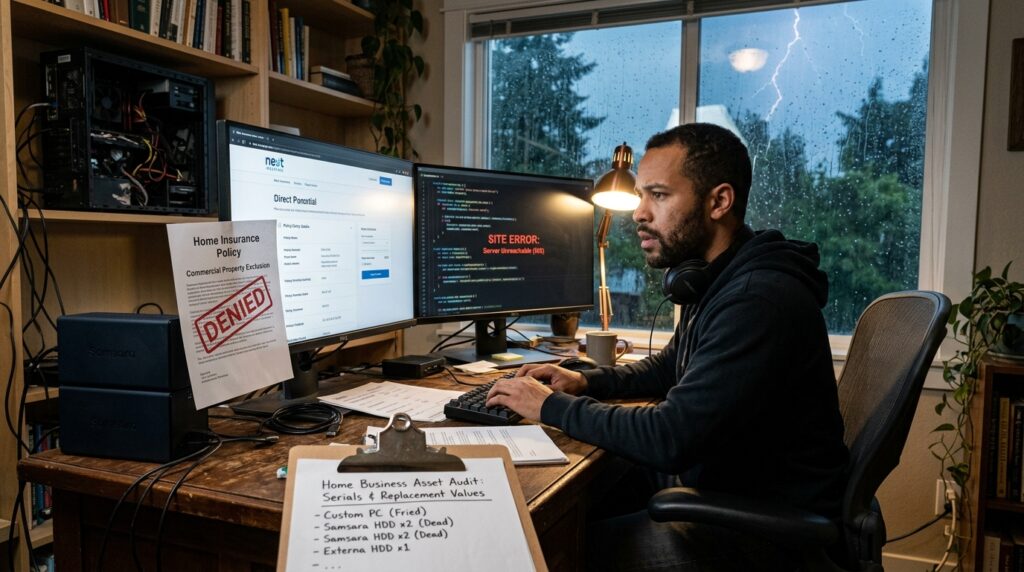
When I first transitioned from working a corporate tech job to running a full-time digital automation and web development business out of my spare bedroom, I felt invincible. I had my high-end dual-monitor setup, a blazing-fast fiber internet connection, and my morning commute was exactly twelve steps from my bed. I figured my standard homeowner’s insurance policy had my back. After all, if my house burned down or got robbed, my stuff was covered, right?
I was dead wrong.
The wake-up call came when a sudden power surge during a summer storm completely fried my main development rig, an expensive custom-built workstation, along with two external backup drives containing active client project files. When I called my home insurance provider to file a claim, the claims adjuster asked a single, seemingly innocent question: “Was this equipment used for any commercial or business purposes?” I answered honestly. Within minutes, my claim was flat-out denied. They pointed directly to the fine print in my policy: home insurance is strictly for personal property. Commercial equipment, inventory, and business liabilities are explicitly excluded, or capped at a useless sub-limit like $2,500—which wouldn’t even cover the graphics card in my setup.
That expensive disaster forced me to dive deep into the world of Home-Based Business Insurance. If you are a solopreneur, freelancer, or digital agency owner operating from a home office, you are running a massive hidden risk every single day until you lock down a proper asset shield.
Let’s break down how home-based business coverage actually works, look at real data configurations, and review the top 10 provider setups for 2026 to keep your workspace airtight.
The Home-Based Risk Reality: Why Your Current Policy Is a Trap
Most solopreneurs assume that because they don’t have clients physically visiting their house, they don’t have any real-world liability. But home-based business risks extend far beyond someone tripping over your rug.
If a client sues your home-based LLC over a data glitch, if a virus leaks from your local server network, or if your physical inventory (like high-value merchandise or backup hardware) gets damaged in a basement flood, your standard home policy will completely leave you stranded.
To bridge this gap, insurance networks offer three distinct operational setups:
- Homeowners Policy Endorsements: A simple add-on rider attached to your existing home insurance. It’s cheap but usually provides very limited coverage (up to $5,000–$10,000 in equipment).
- In-Home Business Insurance Policies: A standalone, specialized policy that offers higher gear limits and a baseline layer of professional liability.
- Business Owner’s Policy (BOP): The gold standard. It bundles Commercial General Liability and Commercial Property insurance into a single package, completely shielding your home asset structure from business ruin.
Top 10 Home-Based Business Insurance Providers (Solopreneur Asset Index)
When you are trying to pick an insurance layer, navigating traditional wholesale broker grids takes too much time. The comprehensive directory matrix below evaluates the top 10 digital and commercial underwriting nodes based on processing speed, direct platform availability, and specific solopreneur risk matching:
| Provider Name | Processing Speed | No-Call Digital Processing | Best Value Framework For | Specialized Asset Shield Feature | Estimated Base Premium (Per Year) |
| 1. Next Insurance | Fast (Under 15 Minutes) | Yes (Direct Portal Node) | Pure Digital Freelancers & Web Devs | Automated Electronics & Data Asset Protection | $350 – $650 |
| 2. Thimble Insurance | Hyper-Fast (10 Minutes) | Yes (Mobile App Sync) | Micro-Agencies & Micro-Niche Bloggers | On-Demand/Pause-able Coverage Adjustments | $300 – $550 |
| 3. Hiscox Business | Standard (1-2 Hours) | Yes (Direct Online Portal) | Independent Tech Consultants & Remote Experts | Global Intellectual Property & Electronic Data Shields | $500 – $900 |
| 4. State Farm | Variable (Requires Agent) | No (Local Underwriter Routing) | Product Sellers & E-Commerce Shippers | Excellent In-Home Physical Inventory Sub-Limits | $450 – $800 |
| 5. Hartford Steam Boiler (HSB) | Structural Review (24 Hours) | No (Wholesale Portal Only) | Tech-Heavy Solopreneurs & Server Hosts | Specialized Cyber-Attack & Tech Equipment Breakdown Coverage | $400 – $750 |
| 6. Progressive Commercial | Standard (24 Hours) | Yes (Via Commercial Hub) | Diversified Freelancers & Multi-Site Owners | Commercial Vehicle Bundling for Multi-Use Vans/Cars | $400 – $700 |
| 7. Liberty Mutual | Standard (2-3 Hours) | Yes (Via Digital Node) | Expanding Home Agencies with Contractors | Subcontractor Property Liability Extension Triggers | $550 – $1,000 |
| 8. Allstate Business | Variable (Requires Agent) | No (Local Broker Network) | Home Studios & Creative Content Producers | Off-Premises Equipment Protection (Gear Used on Location) | $450 – $850 |
| 9. Chubb Small Business | Intensive Audit (24-48 Hours) | No (Digital Underwriter) | High-Net-Worth Solopreneurs & Architects | High-Limit Global Asset & Luxury Home Office Shields | $900 – $1,800 |
| 10. Geico Business | Standard (24 Hours) | Yes (Via Partner Networks) | Part-Time Side Hustlers & E-Com Startups | Baseline General Liability and Low-Tier Equipment Add-Ons | $350 – $600 |
Deconstructing the Home Policy: How Underwriters Evaluate Your Workspace
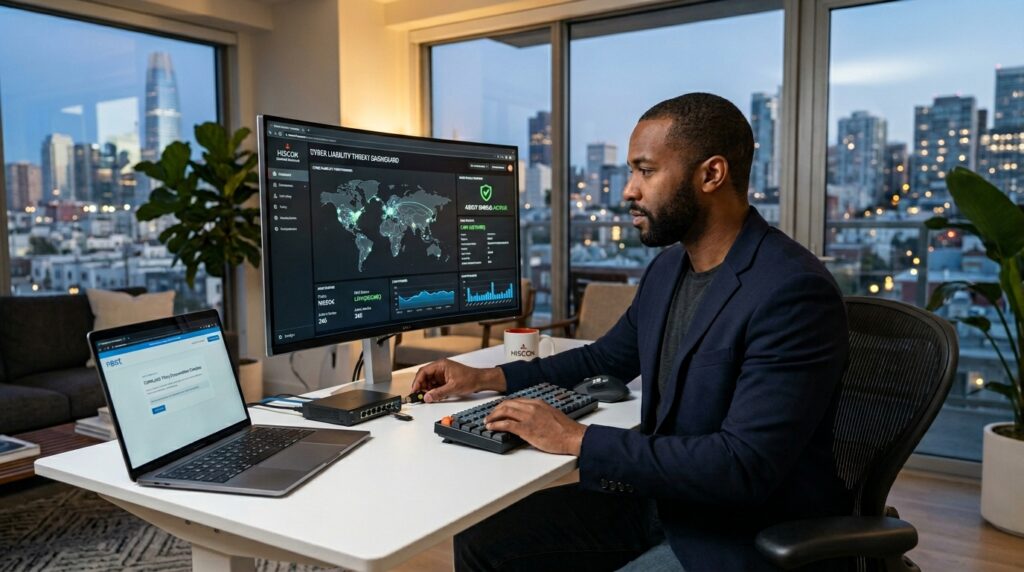
When you submit an application through an online dashboard like Next or Thimble, their automated underwriting scripts run your profile through specific parameters to verify that your business won’t compromise your residential home structure. They look closely at three main data vectors:
1. Physical Business Traffic & Footprint
Do you have delivery trucks dropping off pallets of inventory in your residential driveway every week? Do you have local coaching clients walking into your home office? If your answer is yes, automated systems will immediately route you away from cheap home endorsements and require a full Business Owner’s Policy (BOP) due to the elevated slip-and-fall physical slip risks. If you are 100% digital, your risk index score drops to the safest tier.
2. High-Value Equipment Density
Underwriting scripts calculate your premium based on the replacement value of your hardware. If you are running multiple high-end rendering rigs, expensive network switches, or local storage arrays (NAS), you must specify your total asset replacement value accurately. Platforms like Hartford or Next use this metric to adjust your “Inland Marine” or Business Personal Property (BPP) coverage limit.
3. Electronic Data & Privacy Exposure
If you store sensitive client data, manage payment processing API loops, or store customer PII (Personally Identifiable Information) on a machine inside your home, you face structural cyber liabilities. Top-tier providers like Hiscox or HSB offer cyber security riders that cover the cost of data recovery, system scrubbing, and legal defense if your local home network gets breached by a ransomware loop.
Step-by-Step Guide: How to Properly Insure Your Home Business
Don’t wait for a major fire or an unexpected lawsuit to find out your coverage setup is hollow. Follow this step-by-step framework to secure an airtight asset shield:
Step 1: Run an Equipment and Asset Inventory Audit
Grab a spreadsheet and document every single device required to keep your business alive. Include serial numbers, purchase dates, and current replacement values for your workstation, laptops, monitors, specialized software licenses, and external storage units. Keep this file stored in a cloud environment (like Google Drive) so you can access it instantly if your home office hardware is destroyed.
Step 2: Compare a Standalone BOP against a Home Rider
Call your current home insurance agent and ask what a business endorsement would cost, then run an automated quote through a digital native carrier like Next or Thimble for a standalone Business Owner’s Policy (BOP). In many scenarios, a standalone BOP costs almost the exact same as a generic home rider but gives you 10x higher coverage limits along with a baseline of $1,000,000 in commercial liability protection.
Step 3: Align Your Deductible with Cash Flow
If your home business has a stable emergency fund, set your policy deductible to $1,000 or $2,500. By passing on the option to file minor claims for tiny equipment fixes, your monthly premium costs drop significantly. Use those premium savings to maximize your total policy limit so that your business is truly insulated against catastrophic, business-ending losses.
Real Use Case: How an E-Commerce Solopreneur Saved Their Business
Let’s look at a real-world scenario. An independent solopreneur was running a high-tier digital print and merchandise brand directly out of their finished basement in Ohio. They had invested roughly $18,000 in commercial wide-format printers and raw material stock.
Due to a faulty water heater valve in the house, the basement suffered a flash flood, ruining all the printing equipment and destroying the raw inventory stock within a matter of hours.
Because this operator had set up a dedicated In-Home Business Policy through State Farm rather than relying on standard homeowners insurance:
- The claims adjuster was able to bypass the residential policy limits entirely.
- The business policy immediately initiated a full property loss payout of $18,000 to replace the commercial gear.
- The carrier provided an extra $2,500 under a “Business Interruption” clause to cover lost operational revenue while new machinery was being shipped and configured.
Common Mistakes: Traps to Avoid with Home Business Coverage
Avoid these frequent structural blunders when managing your home-based commercial insurance shield:
- Concealing the Home Business from Your Primary Carrier: Do not hide the fact that you run a full-time business from your main home insurance company. If they discover you are running a high-volume enterprise out of your garage without their knowledge, they can cancel your entire residential policy for failure to disclose material risks. Always be transparent.
- Confusing Business Equipment with Personal Assets: If your personal laptop gets stolen out of your car, your home policy handles it. But if that laptop has your corporate LLC asset tags and is used to manage client servers, your home policy will deny the claim. Keep your business hardware purchased under your business bank account, and insure it under a dedicated commercial certificate.
- Ignoring Off-Premises Coverage Gaps: If you are a mobile tech consultant or an automated channel producer who frequently takes high-end camera gear, laptops, and field recording equipment to coffee shops, hotels, or client sites, make sure your policy includes an “Off-Premises Property” or “Inland Marine” clause. Standard home policies stop covering your business gear the second you step past your front door.
Final Takeaway
Your home might be your castle, but unless it is backed by a dedicated solopreneur asset shield, your business operations are building on shaky ground. Operating a digital agency, e-commerce brand, or consulting setup without clear commercial property and liability isolation is a massive, unnecessary risk.
Take control of your workspace security by choosing a specialized provider from our top 10 index that matches your technical footprint. Audit your physical asset values, configure a balanced deductible structure, and lock down your commercial certificate of insurance. Once your home workstation is fully shielded against unexpected disasters, you can scale your operations and build your digital income streams with absolute confidence and zero anxiety.