
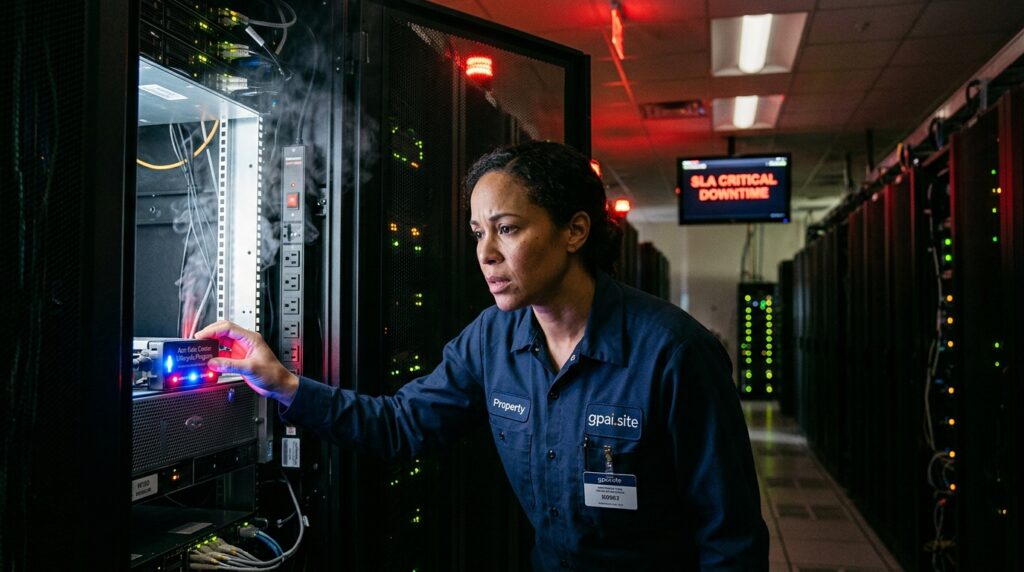
Last year, I decided to scale up one of my data-heavy automation setups. I rented a high-performance cloud instance packed with eight NVIDIA H100 GPUs to train a custom machine learning model for a B2B client. The contract was massive, the timeline was tight, and the compute costs were running at a staggering $4.50 per hour, running 24/7.
At 2:30 AM on a Thursday, a localized thermal runaway event at the data center cluster triggered an automated emergency shutdown. Not only did it kill my active training epoch, but a simultaneous cloud-storage replication error corrupted the underlying checkpoint weights. Three weeks of continuous compute time vanished into thin air, and my deployment deadline missed its target entirely. The client immediately threatened legal action for breach of contract and lost market opportunity, while my cloud billing dashboard still demanded payment for the spinning discs.
When I frantically reviewed my standard Tech Errors & Omissions (Tech E&O) and standard Cyber policies, I hit a massive roadblock. My cyber policy was looking for a malicious hacker or a ransomware loop—not a hardware-level thermal failure. My standard E&O policy treated software code like a traditional deterministic program, leaving huge gray areas around probabilistic model regressions, training data corruption, and high-tier GPU compute infrastructure losses.
That high-stress disaster forced me into a crash course on the structural mechanics of AI Infrastructure & Cloud Server Insurance. In an era where global spending on AI infrastructure is approaching $800 billion annually, running high-performance models or managing cloud server environments without explicit, affirmative infrastructure protections is like building a skyscraper on a foundation of quicksand.
Let’s pull back the curtain on how tech infrastructure insurance actually works, break down the leading provider directories, and map out a bulletproof strategy to protect your compute nodes without overpaying on your premiums.
The Infrastructure Reality: Why Standard Tech E&O Fails the AI Stack
A traditional Tech E&O policy is written for conventional, deterministic software—think basic SaaS apps or e-commerce storefronts. If a bug in your code prevents a user from clicking a button, the error has a clear cause and an easy fix.
AI infrastructure and modern cloud architecture operate on an entirely different plane. The risks are physical, algorithmic, and legal all at once. If your business utilizes localized server racks, acts as an AI vendor, or rents hyperscale computing blocks, your risk profile faces specialized failure vectors that standard policies routinely exclude:
- Model Hallucinations & Underperformance: If an LLM-based agent executing agentic actions (like auto-provisioning database instances, processing trades, or issuing refunds) acts on a confidently incorrect output, it can trigger massive, immediate third-party financial losses.
- Training Data Disputes & Copyright Gaps: If a client gets hit with an intellectual property infringement claim because your model unknowingly trained on proprietary, copyrighted, or non-rights-cleared data arrays, standard advertising injury parameters often fall short.
- SLA Violations from Cloud Downtime: High-performance computing demands flawless uptime. If your hosted infrastructure experiences an automated systemic crash, breaking your Service Level Agreement (SLA) with enterprise clients, the resulting refund mandates can drain your working capital.
- First-Party Compute Resource Loss: If a hardware breakdown destroys an un-checkpointed model training phase, the physical cost of the wasted electricity and GPU allocation hours is rarely covered by standard property insurance.
To protect your business from these modern operational gaps, you need to plug into specific, multi-line insurance solutions designed to bridge the line between raw cloud hardware and active model deployment.
AI Infrastructure & Cloud Server Insurance Directory (B2B Risk Index)
Navigating the traditional enterprise brokerage landscape takes way too long when you need to bind coverage to satisfy a contract review. The directory matrix below analyzes the top specialized underwriters and programmatic facilities providing true multi-line protection for AI developers, infrastructure hosts, and data center operators:
| Provider Name | Processing Speed | No-Call Digital Processing | Best Architectural Matching For | Specialized Infrastructure Shield Feature | Estimated Structural Limit Capacity |
| 1. Aon (Data Center Lifecycle Program – DCLP) | Structural Review (24 Hours) | Yes (Via B2B Integrated Portals) | Hyperscalers, Investors, & Large Cloud Developers | Integrates construction, cargo, cyber, and operational Tech E&O into one line | Up to $2.5 Billion |
| 2. Munich Re (AiSure / AiCert) | Intensive Audit (3-5 Days) | No (Requires Model Validation) | Core AI Model Developers & Analytics Platforms | Direct performance guarantees for algorithmic model outcomes | Custom Enterprise Scale |
| 3. Vouch Insurance | Fast (Under 1 Hour) | Yes (Direct App Interface) | AI Startups, SaaS Providers, & Cloud Nodes | Affirmative coverage options for model hallucinations and API breaks | Up to $10 Million |
| 4. Armilla AI | Fast (24 Hours) | Yes (Automated API Evaluation) | LLM Deployments & Regulated Model Scoring | Specialized coverage for algorithmic bias and EU AI Act compliance failures | Up to $5 Million |
| 5. Tokio Marine Kiln (Professional Ctrl) | Standard (1-2 Hours) | Yes (Via Approved Broker Nodes) | Software Developers & Mixed Cloud Agencies | Combines Tech E&O, Cyber Crime, and Cryptojacking shields into one frame | Up to $25 Million |
| 6. Relm Insurance | Standard (24-48 Hours) | No (Underwriter Review Desk) | High-Risk Compute Networks & Web3 Infra | Explicit coverage options for Agentic action loops and data poisoning attacks | Up to $15 Million |

Deconstructing Infrastructure Protection: The Policy Layers You Actually Need
When structuring an infrastructure policy inside a professional underwriting dashboard, you must look beyond basic general liability. A complete tech protection system requires a modular blend of four distinct insurance vectors:
1. Technology Errors and Omissions (Tech E&O)
This is your primary defense line against third-party claims. If your cloud server setup experiences an API breakage that knocks your clients’ internal integrations offline, or if your machine learning model outputs an error that causes a customer financial harm, Tech E&O steps in. It pays for your dedicated defense attorneys, handles expert courtroom testimonies, and covers resulting financial judgments or contract settlements.
2. First-Party Cyber and Cyber Property Damage
Traditional cyber policies cover the data breach notice letters, but advanced infrastructure policies add Cyber Property Damage. If an adversary launches a targeted data poisoning campaign, executes a massive prompt-injection attack, or installs a stealth cryptojacking script that burns out local hardware cooling loops, this rider pays for forensic server restoration and physical equipment replacements.
3. Business Interruption and Dependent Business Interruption (DBI)
If your own servers go dark, Business Interruption insurance replaces your lost operational revenue. However, if your business relies on external computing clusters (like AWS, Google Cloud, or specialized GPU clouds like CoreWeave), you must verify that your policy includes Dependent Business Interruption. If their system goes dark and takes your deployed models offline, DBI keeps your cash flow stable.
Step-by-Step Strategy: How to Audit, Optimize, and Bind Your Infrastructure Shield
If you are expanding your server footprints or shipping an AI-driven product, follow this systematic step-by-step framework to secure top-tier coverage metrics at the lowest baseline price points:
Step 1: Map Out All Automated AI Decision Boundaries
Before approaching an underwriter, document exactly where your technology can act without prior human approval. Map out your Retrieval-Augmented Generation (RAG) loops, your database access privileges, and your automated API spending caps. Underwriters in 2026 expect to see clear human-in-the-loop review guardrails for high-stakes outputs. Having this architectural map ready instantly lowers your operational risk score.
[Define AI Model Scope] ──► [Map RAG & API Loops] ──► [Implement Human-in-the-Loop] ──► [Submit Validated Tech Stack to Underwriter]
Step 2: Enforce Strict Shadow AI and Data Ingestion Controls
Establish transparent internal governance policies regarding training data input. Create strict “do not paste” rules to prevent employees from feeding proprietary customer data or copyrighted code frameworks into un-vetted third-party foundational models. Underwriters like Munich Re or Vouch will evaluate your data residency, encryption key location management, and vendor oversight protocols during the application audit phase.
Step 3: Utilize a Pay-As-You-Go Layer Linked to Your Active Compute
If you are running irregular model training cycles rather than a static 24/7 cloud server network, work with a modern provider (like Vouch or Tokio Marine Kiln) to adjust your policy thresholds. Configure your deductibles to a stable $2,500 or $5,000 baseline. Raising your deductible keeps your ongoing monthly fixed base premiums incredibly lean, letting you redirect that capital back into buying raw GPU compute time.
Real Use Case: How an Analytics Platform Restored Operations After a Model Regression
Let’s look at a real-world scenario. A B2B predictive analytics platform upgraded its core machine learning model to improve processing times. However, an unexpected model regression occurred after deployment, causing the system to output corrupted algorithmic scores to a corporate enterprise client. Relying on the faulty guidance, the client misallocated their logistics inventory, suffering a direct out-of-pocket financial loss of $110,000. The client filed an immediate breach of warranty lawsuit.
Because the analytics company had moved away from a generic software policy and secured an AI-specific Tech E&O structure through Relm Insurance:
- The underwriter deployed an specialized legal defense team that understood algorithmic model behavior and data dependencies.
- The policy successfully absorbed the legal defense fees and covered the final negotiated contract settlement with the enterprise client.
- The company paid only their predefined policy deductible, completely preserving their operational cash reserves and avoiding corporate bankruptcy.
Common Risks: Blunders That Can Instantly Void Your Server Shield
Avoid these frequent operational errors when managing your cloud and infrastructure protection layers:
- Mislabeled Data Architecture on Applications: When completing online quote drafts, do not list your business as a basic “IT Consulting” company if you are actively managing hyperscale data centers, running cloud clusters, or deploying autonomous AI agents. If a massive system failure occurs and the carrier logs prove you misrepresented your real-world tech stack, they will void the policy for material misrepresentation.
- Ignoring the Policy Retroactive Date: Tech E&O policies are almost exclusively written on a “claims-made” basis. This means the policy that is active the day the claim is filed handles the issue—but only if the original mistake occurred after the policy’s specified Retroactive Date. If you switch insurance carriers, ensure your new provider carries over your original retroactive date, or you will have a massive coverage blind spot for past work.
- Failing to Secure Global/Cross-Border Extensions: If your business is incorporated in the United States, but you utilize server nodes located in European data centers to comply with local data residency rules (like GDPR or DORA), verify your policy’s geographical boundaries. If your policy features a standard “U.S.-Only” limitation clause, a hardware or data incident occurring on an international cloud cluster can be entirely excluded from coverage.
Final Takeaway
Building out advanced AI tools and managing cloud infrastructure is an incredible growth strategy—it is where the entire global technology market is concentrating its capital. But running high-performance workloads without an explicit infrastructure shield is an un-optimized gamble. A single server thermal event, a data poisoning loop, or a model hallucination shouldn’t have the power to collapse your entire business operation.
Take charge of your technical framework by choosing a specialized provider from our B2B directory index that respects the unique reality of probabilistic code and high-performance server grids. Enforce clean data hygiene, optimize your internal model monitoring systems, and lock in your certificate of insurance. Once your cloud infrastructure is fully insulated, you can push your training models to the absolute limit and scale your digital growth strategies with total peace of mind.